Thursday, January 15, 2015

What is Adventure World?


 I've been asked this question a few times since mentioning to fellow gamer friends and enthusiasts that I've been writing my own game. I suddenly realized how fundamentally important it is to know the answer. Not merely to have some text with fancy font to put on the (eventual) book's back cover, but more of a philosophy to keep in mind when writing the game itself. Without a focusing point, it can be easy to get lost in your creation. "Constraint leads to liberation," is a phrase that comes to mind, which has made it much less taxing to make this damn thing. Before I had become cognizant of this fact, the game was a bit of a Frankenstein. Now, it's a Frankenstein with a purpose.


What is Adventure World?

Adventure World is a game inspired by classic fantasy roleplaying games of the 70s and 80s. But it is not an imitation of those games! It’s an homage to the days of gaming where nobody really knew what they were doing, nor did they really care; they were having too much fun -- that’s not to say Adventure World is lacking in rules or is overly complex (the rules are actually kept to a minimum so you and your friends can get to the good stuff.) but rather it encourages the Adventure Master (AM from here on) and players to fill in the blanks--writing a rule for every situation is both impossible and impractical. The most important ones are all there; however, we at Adventure World Inc. trust you are clever enough to create your own should you find them necessary. The term “Golden Arches-ization of Gaming” comes to mind when thinking about a lot of modern games. That is to say, wherever you go, that game will always be run the same way with the same rules. The experience is analogous to visiting a well known fast-food chain: you can usually expect the same thing no matter which one you go to. That’s not necessarily a bad thing, but Adventure World is more about having groups play the game with their own autonomous spirit, much like a mom-and-pop joint off the side of the highway. While some groups might already do this with other gaming systems, Adventure World explicitly encourages this! There are some bits of advice for AMs here and there and example house-rules towards the end of this book, but feel free to add more if you wish . What is Adventure World? That’s really up to you.

Sunday, January 11, 2015

Adventure World Playtest #1


 I got to sit down this weekend with a few friends to take Adventure World for a little test drive. I've got to say, I was a bit solicitous about the game falling to pieces but was pleasantly surprised that our four-hour session went swimmingly -- and that it ended with white-knuckled tension (can't ask for much more than that). I had two players; one played a Human Rogue, and the other played an Elf Warrior.

Adventure World makes use of a 2d8 system for a majority of the rolls in the game: Action rolls, Skill rolls, and Talent rolls. Basically, you roll 2d8 plus modifier(s) and add the total. 7 or less means a failure; 8-11 means success with a consequence; 12 or more is a resounding success.

There are other little mechanics throughout this game, and most of them worked out well. My players made some nice recommendations about the leveling system and rules for item costs. Your character levels up when they fail (7 or less) using one of their two highlighted abilities. (During character creation, the player chooses one ability to highlight, and the player to the left chooses that same player's second ability to highlight.) As I had foreseen, it was a bit easy to meta-game at times and level up quicker. We brainstormed a few ideas for evening things out a bit, and we'll give them a try next time.

For price items, I divide items into 1gp (commoner items); 5gp (adventurer items); 10gp (special items); 25 (luxury items); and 100gp (illegal/inherently dangerous) items. These items cost an amount of gp per syllable. For example, a 5gp adventurer item like a lantern costs 10gp (lan-tern). The more syllables you add to the item, the more expensive it is -- a "hooded lantern" costs 20gp, for example. One player had the brilliant idea that if you add detrimental adjectives to the item, it lowers the price, but there should be a chance (1 in 6 or something) that the item breaks or becomes useless when you try to use it. For example, a mirror (I consider this an adventurer items), is 10gp. but a "cracked mirror" is 5gp. On the opposite end, we discussed that by adding a certain gp amount of beneficial syllables would give you a special circumstantial bonus or something with that item.

These are the ideas that will be consuming my brain for the next week or so.

All in all, we had a great time, and I can't wait for the next playtest.

The character sheet (nothing fancy as of yet...)

The Rogue Talent Tree 


The Warrior Talent Tree.

Friday, January 2, 2015

Adventure World -- My Own Gaming System


As if the world needs another tabletop RPG, right!? I don't care. I'm writing the game that I'd like to play. It's got elements of old-school games, as well as elements of more modern games that I've been playing the last six months or so. Of course, it hasn't reached it's final form yet, but it's getting there. Essentially, it's based on a 2d8 system (as opposed to the d20 system) with other bits and bobbles to add variety, customizability, and its own unique flair. The elevator pitch of the system is what I call the "7-;8-11; 12+" Rule. That is to say, when rolling 2d8 (plus positive/negative modifiers from abilities, skills, talents, or situational circumstances) this main rule governs the results. A 7 or less is a fail with varying consequences. On the plus side, failing is where you gain XP. A result of 8-11 is a moderate success with a minor setback -- you hit your target but they get a counter attack; you steal the gem, but maybe somebody saw you; you convince the merchant, but only if you accept their counter bargain; your spell goes off, but your target has a chance of avoiding it, etc. A 12+ is a resounding success.

I had originally planned to have this "little" game maxed at 20 pages -- boy, was I stupid. I'm now well over 20 pages and believe that it will be completed around the 100-page mark (including class talent and spell descriptions). I've been having a blast writing, playtesting, tweaking, and re-tweaking this little game until the wee hours of the morning. It might be complete within the next few months, only to be completely rewritten again...Who knows? In the meantime, I'll leave you with a few teasers:


The Classes

“The Warrior” – Whether dominating foes with sword and shield, two-handed warhammer, or bow and arrow, the Warrior is unmatched in skill with weapons and armor.

+1 to Act or React and one more +1 bonus that may be added to any ability besides Magic. Warriors are unable to use the Magic ability. Warriors use 1d8 for weapon damage. Warriors begin with three Talent Points that may be used on the Warrior Talent Tree.


“The Rogue”A stealthy shadow-prowler, their footsteps or whispers rarely heard by their quarry before a knife has been put in their chest, or their pockets emptied, the Rogue is a quick-fingered scoundrel.

+1 to React or Sway and one more +1 bonus that may be added to any ability besides Magic. Rogues are unable to use the Magic ability. Rogues use 1d6 for weapon damage. Rogues begin with all Level-1 Scoundrel Talents on the Rogue Talent Tree, and three Talent Points that may be used on the Rogue Talent Tree.


“The Spellcaster” – Equipped with a mind fit to unravel the world’s arcane mysteries, and the ability to weave them into spells of healing, harm, or manipulation, the Spellcaster is one with power like no other.  

+1 to “Magic” or “Wits” and one more +1 bonus that may be added to any ability. Spellcasters use 1d4 for weapon damage. Spellcasters begin with three Talent Points that may be used on the Spellcaster Talent Tree.


The Races

Human

“Humans are the most widespread race, coming from a multitude of backgrounds, and are more well-rounded than other races.”

Racial Traits: +2 Body HP; +2 Mind HP; +2 Soul HP .  
Skills: Humans begin with +1 to any one skill, and can spend five Skill Points.


Dwarf

“Dwarves are short, stout, and hearty. They mostly live underground or in mountain kingdoms, and have an intense fascination with gold, jewels, and well-crafted arms and armor.”

Racial Traits: +6 Body HP; 60’ infravision; cannot use 2-handed weapons or longbows due to small stature; +1 Act vs. poison; +1 Wits vs. spells.
Skills: Dwarves begin with 2 bonus points used in any combination between Dungeoneering and Appraisal, and can spend four Skill Points.


Elf 

“While mentally and soulfully strong, Elves are physically frail compared to other races. They mostly live in forests or away from human settlements, and their sensitive ears and eyes make them all the more aware of what is happening around them.”

Racial Traits: -4 Body HP; +5 Mind HP; +5 Soul HP; 60’ infravision; -2 Act vs. poison; +2 Wits vs. spells.
Skills: Elves begin with +1 Nature and Perception, +1 Dungeoneering when looking for secret doors, and can spend four Skill Points.


Half-Elf
“Having mixed blood, Half-elves do not share all the same boons as Humans or Elves. What they have inherited, however, is a quick tongue and ability to read others. They can be found dwelling among small forest tribes or in the cities of men.”
Racial Traits:+1 Body HP; +3 Mind HP; +2 Soul HP; 30’ infravision, -1 Act vs. poison, +1 Wits vs. spells    
Skills: Half-elves begin with +1 Deception and Insight, +1 Dungeoneering when looking for secret doors, and can spend four Skill Points.


Halfling
Halflings are a bit more vulnerable to physical damage, but are very pure, soulful creatures. Their small stature allows them to sneak around and hide almost anywhere, and their love of reading a good book next to a warm fire has filled their tiny heads with all sorts of knowledge.

Racial Traits: - 2 Body HP; +8 Soul HP; opponents larger than human size attack Halflings at -1; no 2-handed weapons or longbows due to small stature; +2 Wits vs. Soul HP-damaging spells; 1d4 weapon damage dice, regardless of class, but may still advance on Class Talent Trees on one die type lower.
Skills: Halflings begin with +1 Stealth and Lore , and can spend four Skill Points.


Half-Orc
“Half-Orcs are notoriously hardened, but weaker in mind and soul due to corrupted blood. Their greyish or greenish skin and monstrous appearance make them all the more frightening to behold.”

Racial Traits: +12 Body HP; -3 Mind HP; -3 Soul HP; +1 bonus damage to all weapons.      
Skills: Half-Orcs begin with +2 Intimidation and may use Act modifier instead of Sway modifier when using the Intimidation skill, -2 Persuasion, +1 Dungeoneering when looking for secret doors, and can spend four Skill Points.


 Each Class has a Talent Tree. I really like how these are coming along.


 I've still got a lot of work to do, and maybe I'll post updates. I hope by 2016 this game is at least somewhat playable. I've had a few small playtests and we've been having a good time thus far. That's all that really matters, right?....Right?!


Friday, November 28, 2014

The Valley: A Part of the "Burning World" Setting for Mutant Future


First thing to know: The Valley is a hard place--a dead waste of deep canyons, jagged mountains, and open desert filled with radiation and weirdness, all created by "The Final Showdown" the Old Fucks keep going on and on about. Most of us around here live in one of two settlements:


New Haven

Black Sun Union Soldier


In the west there’s New Haven, a clutter of small towns and communities, shadowed beneath a massive complex of steel and concrete we call Tower. New Haven is the domain of Ghost. Nobody has met this Ghost fella, but his Black Sun Union (BSU) is brutally effective at policing New Haven. Life in New Haven isn't all that bad, as long as you do what you’re told. Did a BSU soldier just ask for your gun and jacket for no apparent reason? Just give it to him. Don’t ask questions, got it? If you’re ever sent to Tower, you won’t be coming back. Nobody knows what goes on up there...


Sanctuary

The Witch Lady

Across the canyon wilds to the east lies Sanctuary. Looks like a nice place. Everyone lives in these tall buildings, and they even have trees! How’s that even possible? They also say Sanctuary doesn't have to deal with attacks from strange mutants and other freaky things that live out in the wilds. The Witch Lady’s got some kinda magic or something keeping those creatures out. Folks from Sanctuary worship her like a goddess. They’re good enough people, albeit a bit strange. Must be something in the water…


The Wilds

One of the many colorful fauna awaiting you out in the wilds.


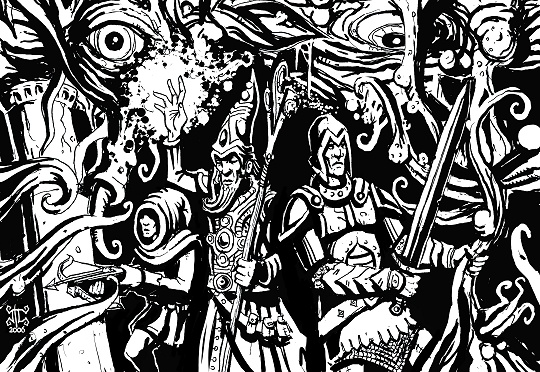
So what else is out there? Well, like I said before, there’s all kinds of strange, mutated creatures wandering outside--after "The Final Showdown", people, animals, everything changed. And not necessarily for the better. You’ve got the Reclaimers, who scavenge everywhere looking for relics of the old world. They prance around, wherever they happen to be, in their power armor like they own the damn place. Rumor is they’re building something. Something big. What else? There are those brave (or insane) caravan traders coming by every now and then. They’ve always got useful things to barter for or interesting tidbits to share about the outside. Sometimes, you’ll see someone selling their child off to some creeps wearing dark robes. These faceless strangers come by more often than we'd like. The Phoenix Society, they call themselves. Not sure what they’re about; don't really want to know, to be perfectly honest. Once in a while we also have to deal with raids by gangs holing themselves up in caves out in the wilds. I heard there’s a big turf war happening between the New Monsters and the Phantoms. Right smack in the middle of the Valley, we’ve got the Lake of Fire in case you feel like contracting radiation sickness or picking up a new mutation.


Someone from the Phoenix Society. I really hate it when they show up.


A member of the Phantoms


And that, ladies and gentlemen, concludes our tour. Enjoy your stay in The Valley.


"Burning World" A setting for Mutant Future


In an instant, everything was gone. A blast of hot white, like a giant eraser on the face of the world--except for those outside the pages of conflict. Nobody really knows what happened, save the Old Fucks. Who listens to them, though? Their brains have turned to mush, and their advocacies are just fantasy...right? Hope? Peace? These words are just a luxury nobody can afford. Sounds beautiful, but who's got time for that when there are blood-thirsty mutants stalking around, or mothers willing to sell their own children for a sip of water or a pinch of bita-min? The Old Fucks say everything went to hell because people couldn't see eye-to-eye. Doesn't sound much different than our situation. I remember hearing someone found a book talking about an "eye for an eye." That sounds much more like the world we live in now. Seems like things never change. Bang bang, baby. Watch your back. Welcome to the Burning World.


Friday, November 7, 2014

"Sorrowfrost" A sandbox setting for Labyrinth Lord


      This originally started out as a little sandbox for some of my Korean middle school students who expressed interest in tabletop rpgs. They would come in during lunch recess every now and then, and I would run them through simple dungeons and wilderness encounters. It was a fun mix of English, Korean...and a lot of body language. Eventually, being kids, they lost interest after a few weeks, but the look on their eyes when I showed them the various mystical polyhedral dice used in this game was enough to tell me they had been changed and realized there is more to gaming than Starcraft and League of Legends.
      I've also been running a pretty successful campaign on the odd weekend here and there for other expat English teachers. I call this setting "Sorrowfrost", which has been written for 1st to 3rd level characters. I won't provide the crunch (on the very, very small chance any of my players find and read this), but here's a little breakdown of each area.

Yeah, I drew this myself... almost immediately after hearing my Korean students express interest in tabletop gaming.


Fairview - A village of roughly 500 human inhabitants living in thatch-roofed homes, surrounded by lush whitewood trees.  Fairview is well known for its elegant spider silks collected from the appropriately named Spider Hills to the southeast.

Fairview Outpost - Where “The Stormchasers” mercenary band - comprised of Barandon Kellegan and his 20 men hired by Sorrowfrost - rest, keep guard, and trade shifts protecting the various villages of Sorrowfrost.  Lately, however, most just sit around drinking or playing cards, as they claim they have not received this month's pay.

Hun Mountains - Mountains forever covered in snow.  The human barbarians of the White Lynx tribe occasionally battle with the Varl, a slowly dwindling race of all-male horned and bearded giants, said to be the first inhabitants of this realm.

Dragon’s Peak - Said to be the highest mountain in the world of Antediluvia.  The summit is also said to be the lair of a large, ancient red dragon.

Wellwind - A village of roughly 200 halflings. They have been known to charge outrageous prices to “tall folk," These ain’t your jolly ol’ Tolkein hobbits!

Laketown - A small village of darkwood homes and buildings, well known for its pumpkin-flavored foods and ale.  Nobody has seen a villager from Laketown since last winter... 

Whispering Hills - An ominous place indeed, shrouded with mist, cries, and whispers.  It is said that you may ask the voices any questions you like, at the possible cost of losing your mind.  A place only the foolish venture to.

Kailind - A coastal stone-walled town for trading vessels. Kailind is known for its exotic goods and diversity. Many an adventurer has started - and ended! - their career on the docks of this precarious locale. Sightings of a massive sea dragon have stopped many ships from leaving or entering Kailind recently, however.

Ghost Fields - It is said the dead remains of ancient warriors from a long-forgotten battle lie buried beneath these rolling hills.  Some say their magical weapons and armor can be dug from the ground, but it is also said the dead will rise if their rest is disturbed.

Kailind Outpost - Another outpost of “The Stormchasers." They were last known to be dealing with a roaming clan of goblins, orcs, ogres, and trolls.

Glades of Elvenspring - A forest of rich greens, reds, and golds.  Said to be the home of elusive elves, brownies, and other Sylvian creatures.

Simon’s Break -A shortcut when traveling between western and eastern Sorrowfrost. Rumors say there it is occupied by vicious bands of gnolls and venomous Tabitha spiders.

Swamp of Troos - Gypsies, fortune tellers, and lizardfolk.  Maybe a wyvern or two.  It is rumored to be the home of a nefarious black dragon and his lizardfolk worshippers.

Deep Rock - Home of the dwarves. Once trading with the other towns and villages, they have currently isolated themselves in their mountain home.

Shadowfell Woods - Said to be inhabited by monsters created by a maniacal wizard long ago who once ruled these lands.  His tower is said to still be located somewhere within these woods.  

Blackfell Keep - Nobody knows much about its past aside from once being a large dungeon where only the most vile criminals were locked away.  

The open road - Everything from roaming goblins and giants to shrines of The Seven are said to be found by anyone brave enough to travel the open roads and wilderness of Sorrowfrost.

Tuesday, July 29, 2014

Musings 6,000 Miles From Home


       Sometimes it's good to get away for a while, from both your comfortable corner of the world, where you know all the sidewalk cracks and routine faces like the back of your hand, and also from your complacent notions and assumptions, where those familiar mental avenues invariably lead you to your incontestable brilliance (in your mind's eye, at least).  I have never claimed to know a lot;  however, I can unquestionably at times get set in my ways.  As I write this, I have spent nearly half a year "getting away for a while." I'm currently residing in South Korea, having left behind my carne asada burritos, delicious local IPAs, cozy brown recliner aside my shelf of gaming books only an arm's distance away, and my hilarious group of Labyrinth Lord and Dungeon Crawl Classics gaming buddies back in sunny Southern California. These magic items have been replaced by extreme weather (it's only a little after nine o'clock in the morning now, and I'm already sweating my nards off),  spicy food creatively prepared from nearly every component of an animal's anatomy, watered-down beer or rice fermented alcohol, a mattress that might as well be made of stone, and a new group of fellow expatriate gamers who have introduced me to gaming systems and philosophies both foreign and intriguing. Sometime's it's good to get away for awhile.
     Admittedly, this isn't the first time I've lived in this country (or abroad, even).  This is actually my fourth year in South Korea--after a two-year hiatus back home in the US.  Actually, I got my feet wet gaming here with 4th edition.  It never really did that much for me, but it did lead me to the discovery of earlier editions of the game, and for that, I'll always be thankful.  This is how I eventually found my niche with Basic D&D and AD&D, eventually leading me to Labyrinth Lord.  While I have run a few sessions of LL here, I've spent more time playing in other people's games.  So far I've played games of Burning Wheel, Mouse Guard, Apocalypse World, Call of Cthulhu, and most recently, Dungeon World. Some I've enjoyed, and some I've found overly complicated. But Dungeon World is a piece of pure brilliance in my opinion.  Will I be a convert, completely changing my gaming system of choice?  No.  Will I take advantage of the neat quirks and mechanics and apply them to my own?  You betcha. While the purpose of this blog is not about discussing travel and experiencing new cultures, I'd just like to say that it's inevitable that by doing so, you will change as a human being.  You begin to lose your "frog in the well" mentality. And while I have had many real-life experiences running the gamut from mind-numbing frustration to holy-guacamole-this-is-amazeballs wonder--some days are reminiscent of a scene right out of Lost in Translation-- my experiences from a purely gaming perspective have not taken a back seat at all during this time, and have, in fact, run parallel with them. My only explanation for this is that while living abroad, one is almost forced to change one's mindset on a daily basis, allowing an influx of new ideas and influences to be absorbed into a mind that would normally eschew them.
      "What's so great about Dungeon World, anyway," you ask?  Well, a lot of things.  But what I am really excited about borrowing and  incorporating into my Labyrinth Lord and Dungeon Crawl Classics games has to do with the idea of 'failure', or rather, spicing things up a lot more when the dice rolls don't go your way, making 'failure' an interesting component to the game. I'm not going to go into detail about the mechanics but  essentially, there is a target number needed to succeed in a skill or attack.  When hitting the target number or above, you achieve your goal -- you stab the ogre, find the secret door, or seduce the busty barmaid.  Rolling below that number, on the other hand, is where things get interesting; hitting a little below the mark grants you success. But not completely --  you hit the ogre, but damage your weapon; you find the secret door, but make a helluva lot of noise; you seduce the barmaid, but her big, hairy, and barrel-chested lover breaks down the door and comes after you with an axe, etc.  Rolling really low, well, that's where you actually gain XP.  Now I can't see myself incorporating that last bit. As we already know, most XP is gained from finding treasure (in Labyrinth Lord, at least), and I'd like to keep things that way.  Nevertheless, I think I will start incorporating a similar mechanic in my games where a result of 1-3 -- or 4...or 5, if there's good beer flowing at the table -- below the target number for a skill check grants a success, but with an evil little twist.  Fumbles will, of course, still only happen on critical failure -- a 'natural 1' in my games.
        ...Whew, are you still there?  If you've made it this far, I applaud you.  I'm aware that this is an awfully long post to explain one tiny little change I will apply to my own games, but I've been making a lot of subtle changes as of late (you can see a bunch of new editions to my list of House Rules here: http://ominousentries.blogspot.kr/2014/02/house-rules.html ), which got me thinking. These changes must stem from the fact that I've been taken out of my homespun surroundings, allowing me to add new and commoving constituents to a previously all-too-familiar homebrew. I can only await the changes to come in another six months time.